
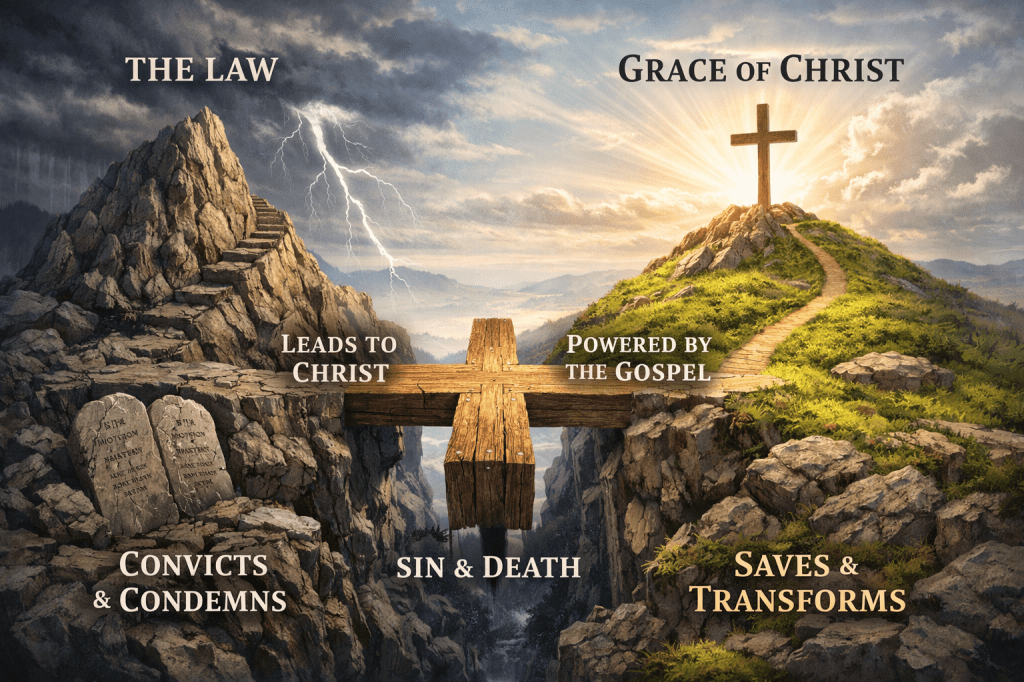
In my preaching, I affirm that the law must be preached as God’s holy standard so that it examines, exposes, and defines real holiness.
I affirm that the law must unmask hypocrisy, confront sin honestly, and expose false assurance where it exists.
I affirm that there are moments when the primary purpose of preaching the law is to prepare the heart for Christ by unmasking unrighteousness and stripping away self-confidence.
I affirm that antinomianism is real and deadly, especially in cultural Christianity where people presume safety while remaining unchanged.
I affirm the necessity of warning, exhorting, pressing repentance, and calling people to obedience with biblical seriousness.
I affirm that obedience is not optional, holiness is not optional, and the commands of God are not light.
I refuse to preach grace in a way that sentimentalizes sin or bypasses repentance.
I affirm that the law—whether Old Testament or New Testament command—never supplies the power it demands.
I reject preaching that repeatedly issues commands to believers as though the command itself were the means of transformation.
I affirm that sanctification is not driven primarily by mental effort, discipline, or “trying harder,” but by active, present, daily dependence on Christ.
I affirm that believers grow by faith in Christ’s promises, reliance on the Spirit, and continual access to grace through our Great High Priest.
I reject the idea that justification is God’s work, glorification is God’s work, but sanctification is left largely to human effort.
I affirm that the entire Christian life is lived by grace—grace that pardons, grace that empowers, grace that produces obedience.
I affirm that the gospel is not merely the doorway into the Christian life but the lifeblood of the Christian life.
I affirm that lawful living for believers is paved with the gospel, not powered by law-driven striving.
I reject trusting law more than gospel to produce real holiness, even when the concern is widespread unholiness in the church.
I reject treating grace received at conversion as though it automatically makes sanctification a self-driven project.
I also reject gospel-only preaching that never challenges obedience, never examines with the law, never calls out false assurance, and treats sin lightly.
I affirm that the gospel does not weaken holiness but creates it.
I affirm that the Spirit uses both law and gospel in their proper channels, not as a mixture but by distinct means.
I affirm the law as the target that reveals what the Christian life should look like, not the engine that makes it happen.
I insist that the gospel is the engine that supplies what the law requires through Christ and the Spirit.
I affirm that faithful preaching must both warn and warm—warning the presumptuous without crushing the tender, and comforting the struggling without granting peace to the unrepentant.
I affirm that this kind of preaching will often be misunderstood and accused of imbalance precisely because it refuses both legalism and antinomianism.
I believe this approach requires more theological precision, more patience, more trust in the Spirit, and less control over outcomes.
I am convinced it is the biblical path: law that truly exposes and directs, gospel that truly saves and empowers, and obedience that is real, supernatural, Christ-exalting, Spirit-enabled, and sustained by ongoing dependence on grace—not by law-based labor.
 Passionate Grace
Leave a comment